
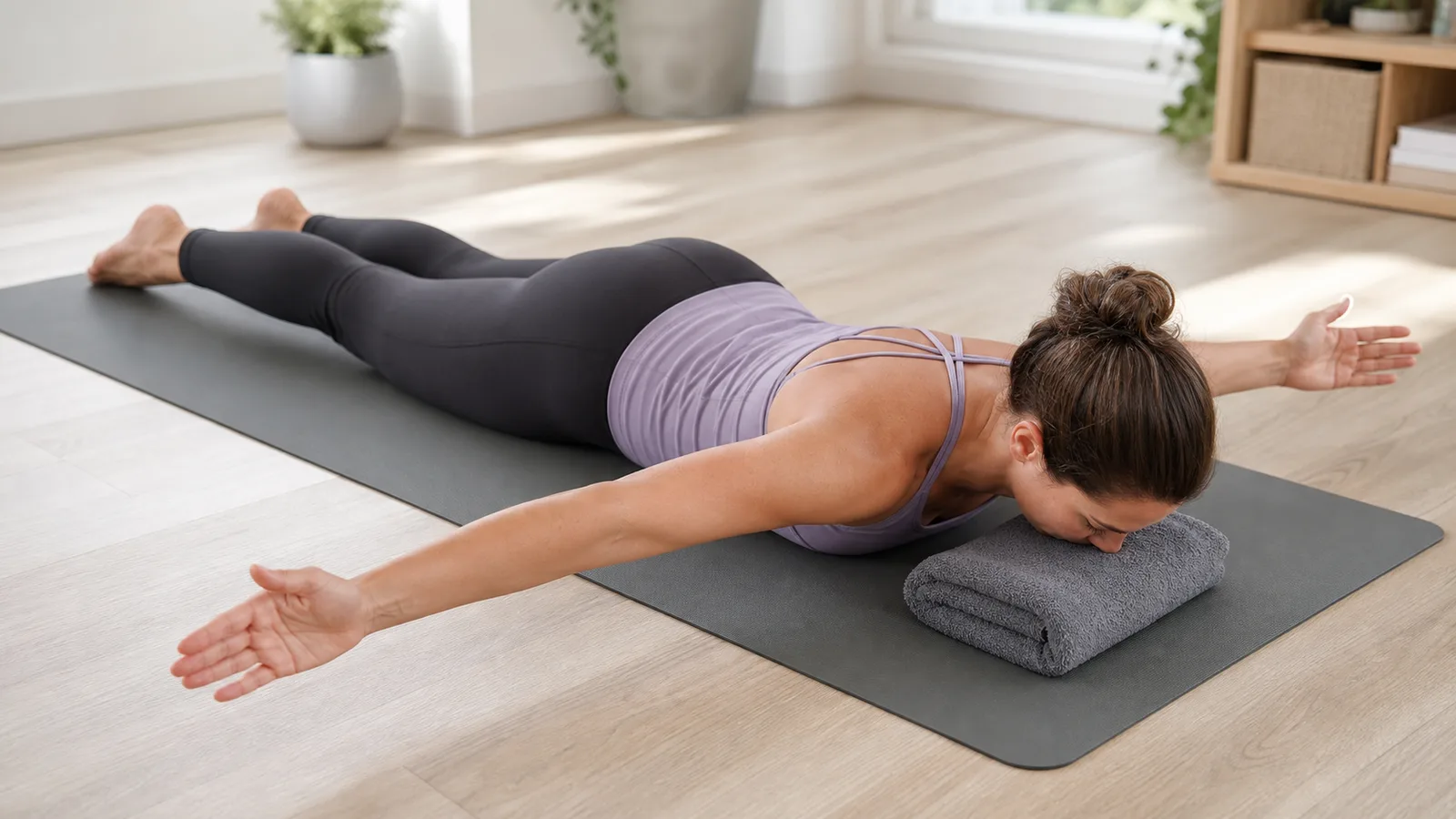
Reverse snow angels are a floor-based upper-back and shoulder exercise. You lie face down and sweep your arms from your sides toward overhead, similar to making a snow angel with your chest facing the floor. The goal is controlled shoulder-blade movement and a comfortable range—not lifting the hands as high as possible.
How to do reverse snow angels
Lie face down with your legs long, forehead on a folded towel, and arms near your sides. Gently brace your abdomen and keep the front of your hips heavy on the floor. Turn the thumbs away from the floor if that makes the shoulder position more comfortable.
Lift the hands and shoulders only slightly, then sweep the arms out and overhead without shrugging. Reverse the path slowly. Stop before your ribs flare, lower back arches, or hands lose control. Begin with six to ten smooth repetitions.
| Body area | What to do | What to avoid |
|---|---|---|
| Neck | Keep it long with eyes toward the floor | Looking forward and compressing the neck |
| Ribs | Keep them gently drawn toward the pelvis | Arching to fake more shoulder range |
| Shoulders | Move in a comfortable, controlled arc | Forcing painful overhead motion |
| Hands | Hover lightly or slide on the floor | Adding weight before control is easy |
What muscles do reverse snow angels work?
The movement challenges muscles that position the shoulder blades and help the arms travel overhead, including parts of the trapezius, rhomboids, rear shoulders, and rotator cuff. The spinal extensor muscles may work isometrically to hold your torso, but the exercise should not feel like a lower-back lift.
Reverse snow angels can complement pressing and desk-heavy days, but they are not a complete back program. Rows and pulldowns allow more progressive loading, while this drill emphasizes control and range.
Make the exercise easier or harder
For an easier version, keep the hands on the floor and slide them, shorten the arc, or perform wall slides while standing. If lying face down is uncomfortable, a standing wall variation can train a similar pattern without pressure on the front of the body.
To progress, pause for one or two seconds at challenging points or use a very light resistance band. ACE also describes a light water-bottle variation, but load should remain small because the long lever quickly increases difficulty.
- Easier: floor slides with the hands supported
- Easier: standing wall snow angels
- Standard: hands hovering through a comfortable arc
- Harder: slow three-second sweep with pauses
- Harder: very light bottles only after clean bodyweight repetitions
Common mistakes and shoulder warning signs
The most common mistake is trading shoulder motion for a larger back arch. Keep the range smaller and let mobility improve gradually. Another mistake is pulling the shoulder blades down aggressively through the entire arc; they need to rotate as the arms travel overhead.
Stop for sharp pain, pinching, numbness, or symptoms that continue after the set. Shoulder pain has many possible causes, and a general exercise cannot diagnose or correct an injury.
A short upper-back pairing
Use reverse snow angels after a warm-up or near the end of an upper-body session. Complete two rounds with relaxed breathing and no rush.
| Exercise | Repetitions | Focus |
|---|---|---|
| Reverse snow angels | 6–10 | Slow shoulder-blade control |
| Bird dog | 6 per side | Stable trunk and hips |
| Incline push-up | 6–12 | Controlled pressing |
| Band or cable row | 8–15 | Progressive pulling strength |
Frequently asked questions
Are reverse snow angels good for posture?
They can strengthen and rehearse shoulder-blade control, but posture changes throughout the day and is not fixed by one exercise. Regular movement, varied positions, and broader strength work also matter.
Should my hands touch the floor?
They may hover or slide. Choose the version that lets you move smoothly without pain, shrugging, or arching your lower back.
This article provides general fitness information, not individual medical advice. Choose movements suitable for your ability and speak with a qualified professional when you have pain, an injury, or a health concern.
Sources
Jamie’s Fit uses authoritative health guidance to review general exercise recommendations.