
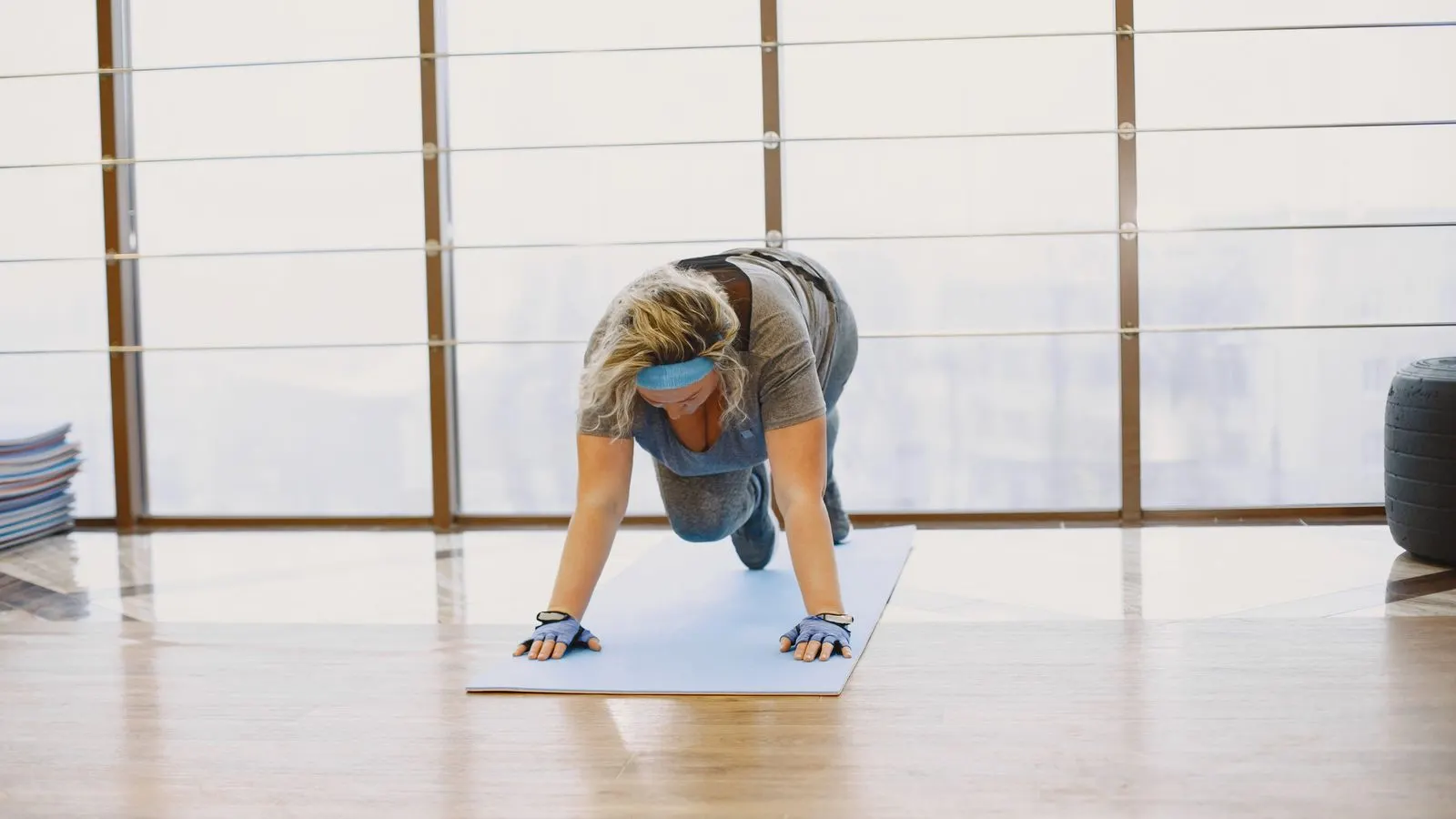
This bodyweight exercise program for beginners gives you two repeatable full-body workouts and a four-week schedule you can do at home. You do not need to master every exercise on day one. Start with the easiest version you can control, leave time to recover, and progress one small step at a time.
Your four-week beginner workout schedule
Alternate Workout A and Workout B with at least one easier day between strength sessions. Walking, gentle mobility, or another comfortable activity can fill the other days. The goal is to practice the main movement patterns without making every day a hard workout.
The schedule below begins with two strength days and adds a third only after you have had time to learn the movements. If two days still feel challenging in week three, repeat week two instead. A useful plan adapts to your starting point.
| Week | Monday | Wednesday | Friday | Focus |
|---|---|---|---|---|
| 1 | Workout A | Walk or mobility | Workout B | Learn each movement |
| 2 | Workout B | Walk or mobility | Workout A | Repeat with steady form |
| 3 | Workout A | Workout B | Workout A | Add a third day if ready |
| 4 | Workout B | Workout A | Workout B | Add reps or one set |
Move the days to fit your week. What matters is keeping recovery between strength sessions and choosing a workload you can repeat.
Warm up before each workout
Begin with five to ten minutes of easy movement. March in place, circle your shoulders, practice slow sit-to-stands, and perform the first exercise with a smaller range of motion. Gradually increasing your pace prepares you for the session more comfortably than jumping straight into the hardest set.
You should feel warmer and able to breathe a little faster, not tired. Use the warm-up to check how your body feels and choose the exercise variation that makes sense today.
- One minute of easy marching or walking around the room
- Five slow shoulder circles in each direction
- Five controlled sit-to-stands from a chair
- Five hip hinges with your hands on your hips
- A short practice set of the first two exercises
Workout A: squat, push, hips, and core
Complete each exercise in order. Rest long enough to begin the next set with controlled breathing and steady technique. Start with one set in week one; move to two sets when the full circuit feels manageable.
| Exercise | Starting target | Make it easier |
|---|---|---|
| Chair squat | 6–10 controlled reps | Use a taller chair and your hands for support |
| Wall or counter push-up | 5–10 controlled reps | Use a more upright surface |
| Glute bridge | 8–12 controlled reps | Use a smaller range of motion |
| Dead bug heel tap | 5–8 reps per side | Move one leg at a time |
| March in place | 30–45 seconds | Slow the pace or hold a chair |
End a set when you can no longer keep the same controlled form. More repetitions are not useful when every repetition looks different.
Workout B: legs, hinge, upper back, and stability
Workout B changes the movement emphasis while staying beginner-friendly. A completely equipment-free program has limited pulling options for the back, so the prone W raise builds control rather than replacing a loaded row. If you own a resistance band, add a band row after the W raise.
| Exercise | Starting target | Make it easier |
|---|---|---|
| Supported split squat | 5–8 reps per side | Hold a chair and shorten the range |
| Bodyweight hip hinge | 8–12 controlled reps | Practice the motion against a wall |
| Incline push-up | 5–10 controlled reps | Choose a higher surface |
| Prone W raise | 6–10 controlled reps | Keep hands on the floor between reps |
| Bird dog | 5–8 reps per side | Move only an arm or only a leg |
| Calf raise | 8–15 controlled reps | Use a chair for balance |
How to progress the plan
Progress does not require a brand-new routine every week. First make the plan consistent. Then add one or two repetitions, add a second set, slow the lowering phase, or choose a slightly harder variation. Change only one variable at a time.
For example, move a wall push-up to a kitchen counter only after you can complete your current version without losing body position. For squats, lower the chair height gradually or pause briefly above the seat. Small changes make progress easier to judge.
- Week 1: learn the exercises with one comfortable set
- Week 2: repeat the same versions and add reps where form stays steady
- Week 3: add a third workout day or a second set—not both at once
- Week 4: add reps, a set, or a harder variation to one or two movements
What to do after week four
Repeat the final week if it still feels productive. You can also continue to a harder push-up, squat, or core variation, or add simple resistance for movements that are difficult to train with bodyweight alone. There is no deadline for moving beyond a beginner plan.
For broader health benefits, gradually combine strength work with aerobic activity you enjoy. U.S. guidance for adults describes a long-term target of 150 to 300 minutes of moderate aerobic activity each week plus muscle-strengthening activity on at least two days. Beginners can build toward that target over time; some activity is better than none.
Frequently asked questions
Can a beginner do bodyweight exercises every day?
You can move every day, but hard full-body strength sessions do not need to happen daily. This plan places easier days between strength workouts so you can practice consistently and notice how you recover.
How long should a beginner bodyweight workout take?
One set of this plan may take about 15 to 25 minutes, while two sets may take longer. The right length is the amount you can complete with controlled form and repeat during the week.
What if I cannot do a push-up?
Start with a wall or high-counter push-up. A more upright position reduces the load. Lower the surface gradually as your control improves.
Is this a beginner calisthenics workout with no equipment?
Yes. Calisthenics uses your body as resistance, and the main plan requires no equipment beyond an optional chair or counter for support. A resistance band is optional for adding more pulling work.
This article provides general fitness information, not individual medical advice. Choose movements suitable for your ability and speak with a qualified professional when you have pain, an injury, or a health concern.
Sources
Jamie’s Fit uses authoritative health guidance to review general exercise recommendations.