
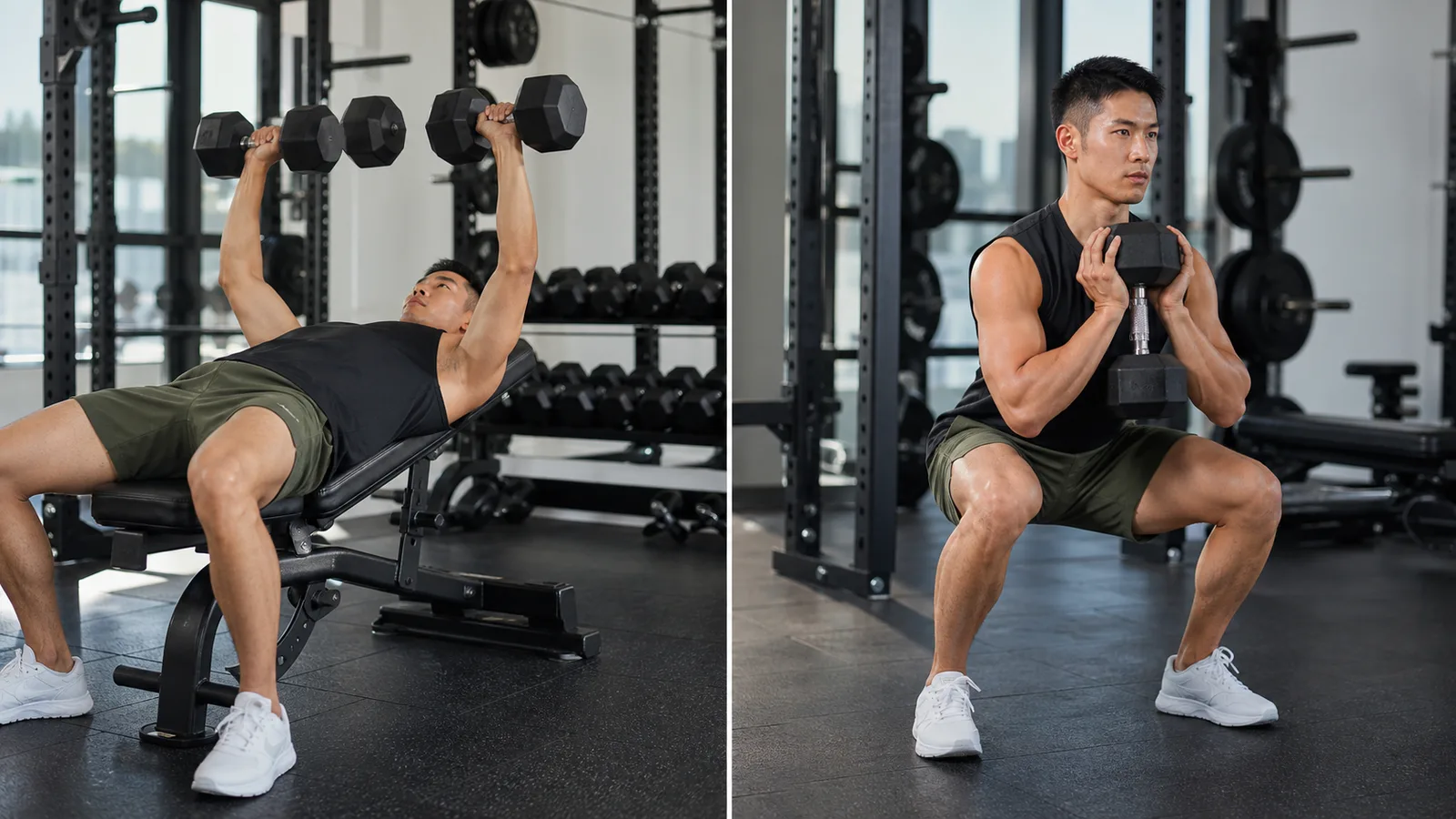
A four-day workout split gives you enough room for two upper-body and two lower-body sessions without training every day. The schedule below balances movement patterns, trains each major muscle group twice, and leaves space for recovery. It suits people who already tolerate three strength sessions and can reliably protect four weekly time slots.
The four-day upper/lower schedule
A common week is upper body Monday, lower body Tuesday, rest Wednesday, upper body Thursday, and lower body Friday. Move the days as needed while avoiding four hard sessions in a row.
Begin with two sets for accessory exercises and two or three for the main lifts. More volume is not automatically better; earn it by recovering and progressing.
| Day | Focus | Main patterns |
|---|---|---|
| Upper A | Horizontal push and pull | Bench press, row, pulldown, shoulders, triceps |
| Lower A | Squat emphasis | Squat, Romanian deadlift, leg curl, calves, core |
| Upper B | Vertical push and pull | Overhead press, pulldown, incline press, row, biceps |
| Lower B | Hip emphasis | Deadlift or hip thrust, leg press, split squat, leg curl, carry |
Upper A workout
Rest two to three minutes after demanding presses and rows, and about one to two minutes after smaller isolation exercises. Use a load that leaves one to three controlled repetitions in reserve.
| Exercise | Sets × reps | Alternative |
|---|---|---|
| Bench press | 3 × 6–10 | Dumbbell or machine press |
| Seated cable row | 3 × 8–12 | Chest-supported row |
| Lat pulldown | 2 × 8–12 | Assisted pull-up |
| Lateral raise | 2 × 10–15 | Cable lateral raise |
| Cable pressdown | 2 × 10–15 | Overhead extension |
Lower A workout
Use a squat depth and stance you can control. The Romanian deadlift trains the hip hinge, while the seated curl adds direct knee-flexion work for the hamstrings.
| Exercise | Sets × reps | Alternative |
|---|---|---|
| Back squat | 3 × 6–10 | Goblet squat or leg press |
| Romanian deadlift | 3 × 6–10 | Dumbbell RDL |
| Seated leg curl | 2 × 10–15 | Slider curl |
| Standing calf raise | 2 × 10–15 | Leg-press calf raise |
| Dead bug | 2 × 6–10 per side | Front plank |
Upper B and Lower B workouts
The second pair changes angles without turning the week into four unrelated workouts. Keep the same exercises for several weeks so you can measure progress.
| Upper B | Lower B | Sets × reps |
|---|---|---|
| Overhead press | Trap-bar deadlift or hip thrust | 3 × 6–10 |
| Pulldown or pull-up | Leg press | 3 × 8–12 |
| Incline dumbbell press | Split squat | 2 × 8–12 |
| Wide-grip or chest-supported row | Lying leg curl | 2 × 8–15 |
| Dumbbell curl | Farmer carry | 2 sets |
How to progress and when to reduce volume
Use double progression: add repetitions within the listed range, then increase the load when every set reaches the top with stable technique. Small increases are enough. If a lift stalls, first check sleep, food, rest periods, and whether the load jump was too large.
Reduce a set from each exercise during unusually stressful weeks or when soreness and performance do not recover between sessions. You can also return temporarily to three full-body days if four appointments stop fitting your life.
If you are completely new to strength training, learn the movements on two or three full-body days first. Four days should make training easier to distribute, not harder to sustain.
Frequently asked questions
Is a 4-day workout split enough to build muscle?
Yes. Four days can comfortably distribute effective weekly volume across every major muscle group while leaving recovery days.
Can beginners use a 4-day split?
They can, but two or three full-body days are usually simpler for learning movements and testing recovery. Move to four days when the extra schedule solves a real problem.
What should I do on rest days?
Rest days can include normal daily activity, walking, or comfortable mobility. They do not need to become hidden high-intensity workouts.
This article provides general fitness information, not individual medical advice. Choose movements suitable for your ability and speak with a qualified professional when you have pain, an injury, or a health concern.
Sources
Jamie’s Fit uses authoritative health guidance to review general exercise recommendations.